Lesson 16 of 29
Minimum top-up tax and permanent establishment assessments
What you will be able to do
This lesson is for the tax manager. You will record an assessment that shows whether the group falls under the domestic minimum top-up tax, and run a permanent establishment assessment for a foreign business that works with the entity.
Before you start
- You are signed in with the Tax manager role for Meridian Souq Trading LLC.
- For the top-up tax you know the group's consolidated revenue in euros. Meridian Souq Group turns over about 24 million euros, far below the threshold.
- For the permanent establishment assessment you know how the foreign business operates in the United Arab Emirates: whether it has premises, an agent, a building site or staff providing services here.
Steps
- 1
Open Tax Intelligence, select More, then DMTT
In the left menu choose Tax Intelligence and select More. Under Corporate tax structure, select DMTT, Pillar Two. DMTT is the domestic minimum top-up tax. It applies to multinational groups with consolidated revenue of 750 million euros or more in at least two of the four preceding years, and makes sure their profit here is taxed at 15 percent at least. The list on the left sorts assessments into Draft, Computed and Filed.
- Select More
- 2
Select New Assessment and enter the year and the revenue
Select New Assessment. In Fiscal Year type 2025. In Consolidated Revenue, which is in euros, type the revenue of the whole group: 24000000. The line underneath repeats the threshold of 750 million euros.
- Select New Assessment
- Type e.g. 750000000:
24000000
- 3
Enter the tax and income figures
Covered Taxes is the corporate tax on the group's profit here, in dirhams: 942750. GloBE Income is that profit worked out under the minimum tax rules: 10895000. Substance-Based Exclusion is a carve-out for payroll and tangible assets, which reduces the profit the top-up rate applies to; leave it empty. Safe Harbour Type is optional and offers three simplifications; leave None.
- Type e.g. 1200000:
942750 - Type e.g. 10000000:
10895000
- Type e.g. 1200000:
- 4
Add a note and select Create Assessment
In Notes record why the assessment was made. Then select Create Assessment.
- Type Additional notes...:
Group revenue is about EUR 24 million, below the EUR 750 million thres… - Select Create Assessment
- Type Additional notes...:
- 5
Read the assessment in the list
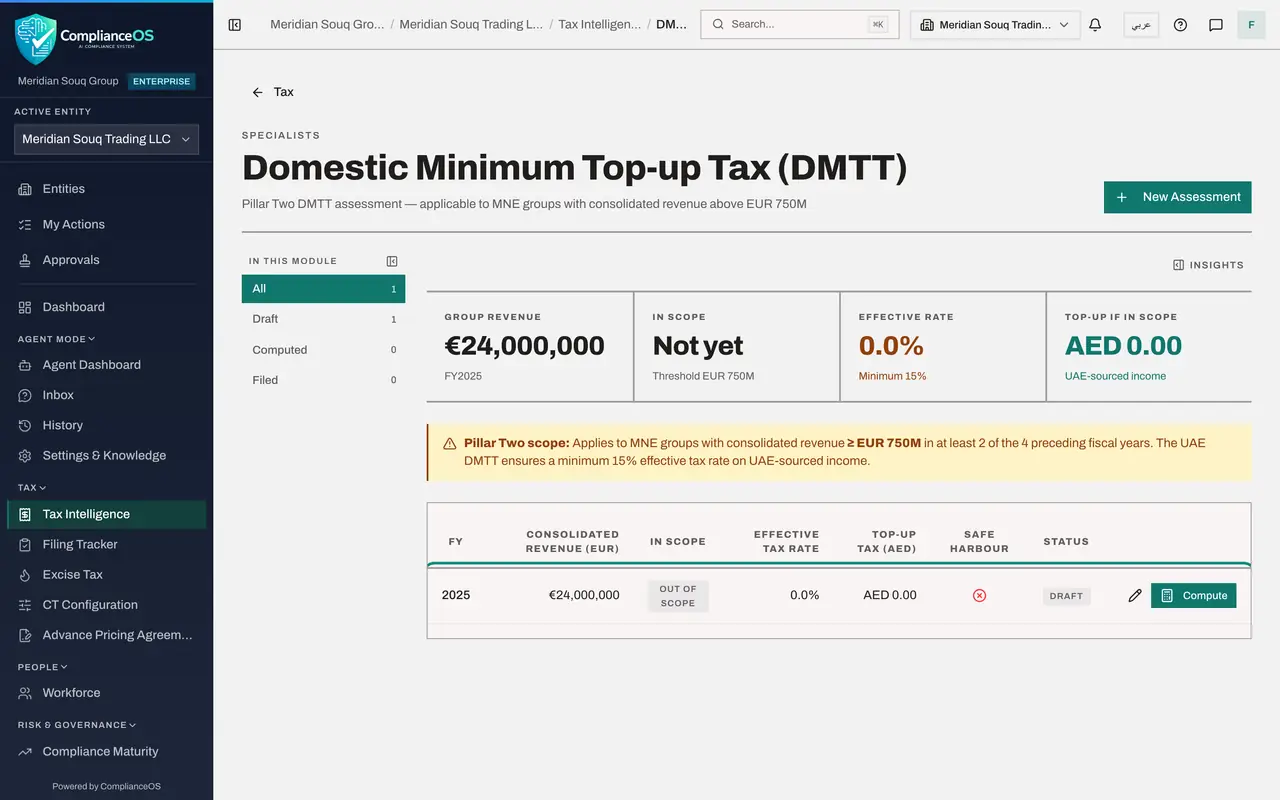
Four tiles summarise the latest assessment: group revenue of 24 million euros, In scope reads Not yet, the effective rate, and the top-up tax if the group were in scope, which is zero. The row for 2025 is marked Out of scope and Draft. The pencil opens it for correction. Compute works out the effective tax rate and the top-up for a group that is in scope. Keep one assessment for each year, so the file shows the question was checked.
- 6
Go back to More and select PE Assessment
Go back to Tax Intelligence, select More, then PE Assessment. PE means permanent establishment: a taxable presence of a foreign business in the Emirates. The blue note lists what creates one: a fixed place of business, a dependent agent who signs contracts, a building site lasting more than 183 days, or services provided here for more than 183 days. Work that is only preparatory or auxiliary does not create one.
- 7
Select New Assessment and identify the foreign business
Select New Assessment. A questionnaire opens. In Non-Resident Name type the foreign business: Harbourline Imports Ltd, a supplier in the United Kingdom. In Country type its three-letter code, GBR. In Fiscal Year type 2025. In Applicable DTA name the double tax agreement between the two countries, if there is one.
- Select New Assessment
- Type Company or person name:
Harbourline Imports Ltd - Type e.g. GBR, USA:
GBR - Type Fiscal Year:
2025 - Type e.g. UAE-UK DTA Article 5:
UAE-UK DTA
- 8
Answer the questions about its presence
Four switches follow, one for each way a permanent establishment arises: a fixed place of business, a dependent agent, a construction site and service provision. Switching one on opens boxes for the details. Harbourline ships goods from Bristol and has no premises, agent, site or staff here, so leave all four off. Under Exceptions and Special Cases leave both switches off as well.
- 9
Add a note and select Run PE Assessment
In Notes summarise the facts. Then select Run PE Assessment at the bottom of the questionnaire.
- Type Notes:
Goods are shipped from the United Kingdom under purchase orders. No of… - Select Run PE Assessment
- Type Notes:
- 10
Read the result
The assessment is listed with the foreign business, its country, the year, the result No PE, no indicators, and the tax agreement. The box underneath states the conclusion in words: no permanent establishment indicators identified. The pencil reopens the questionnaire and the bin deletes the assessment. Run a new one whenever the way a foreign business works here changes.
How to check it worked
The DMTT screen lists an assessment for 2025 and the Permanent Establishment Assessment screen lists one for Harbourline Imports Ltd, each with its result.
Common mistakes
- Entering revenue in dirhams in Consolidated Revenue. That box is in euros, because the 750 million threshold is set in euros.
- Using the entity's revenue instead of the group's. The test looks at the consolidated revenue of the whole multinational group.
- Ticking Activities are solely preparatory or auxiliary to make a permanent establishment go away. That exception only applies to work such as storage or collecting information, and you may have to prove it.
Check your understanding
1. Which groups come under the domestic minimum top-up tax?
- A.Every company with revenue above AED 3 million
- B.Multinational groups with consolidated revenue of EUR 750 million or more in at least two of the four preceding years
- C.All free zone companies
- D.Companies with more than 250 employees
Show answer
Answer: B. Multinational groups with consolidated revenue of EUR 750 million or more in at least two of the four preceding years
The top-up tax brings the effective rate on such a group's local profit up to 15 percent. Smaller groups are out of scope.
2. What is a permanent establishment?
- A.A company's registered office
- B.A taxable presence of a foreign business in the country, such as premises, a dependent agent, a long building project or services provided here for more than 183 days
- C.A long-term lease
- D.A bank account
Show answer
Answer: B. A taxable presence of a foreign business in the country, such as premises, a dependent agent, a long building project or services provided here for more than 183 days
A foreign business with a permanent establishment here is taxed here on the profit that belongs to it.