Lesson 13 of 24
Read gratuity provisions and estimate an end-of-service payment
What you will be able to do
This lesson is for the HR team and for finance colleagues who ask HR for figures. Gratuity is the end-of-service payment an employee is owed when they leave. You will read what the company is building up for each employee, and work out what one person would receive if they left today, from the list and from their record.
Before you start
- You are signed in with an HR role that can edit employees. In the demo company that is the HR director.
- Each employee's start date and basic salary are correct, because gratuity is worked out from those two.
Steps
- 1
Select the Gratuity Accruals tab
In Workforce select Gratuity Accruals. Each current employee has a row with their years of service, the amount that builds up each month and the total provision so far. At the top right, Monthly and Outstanding add up the whole entity: the first is what one more month costs, the second what the company would owe in all.
- Select Gratuity Accruals (End-of-Service Provisions)
- 2
Read one employee's row
The merchandising buyer has the longest service, close to eight years, and therefore the largest provision. The line under the table gives the date the figures were worked out and names the law they follow.
- 3
Select Gratuity on an employee's row
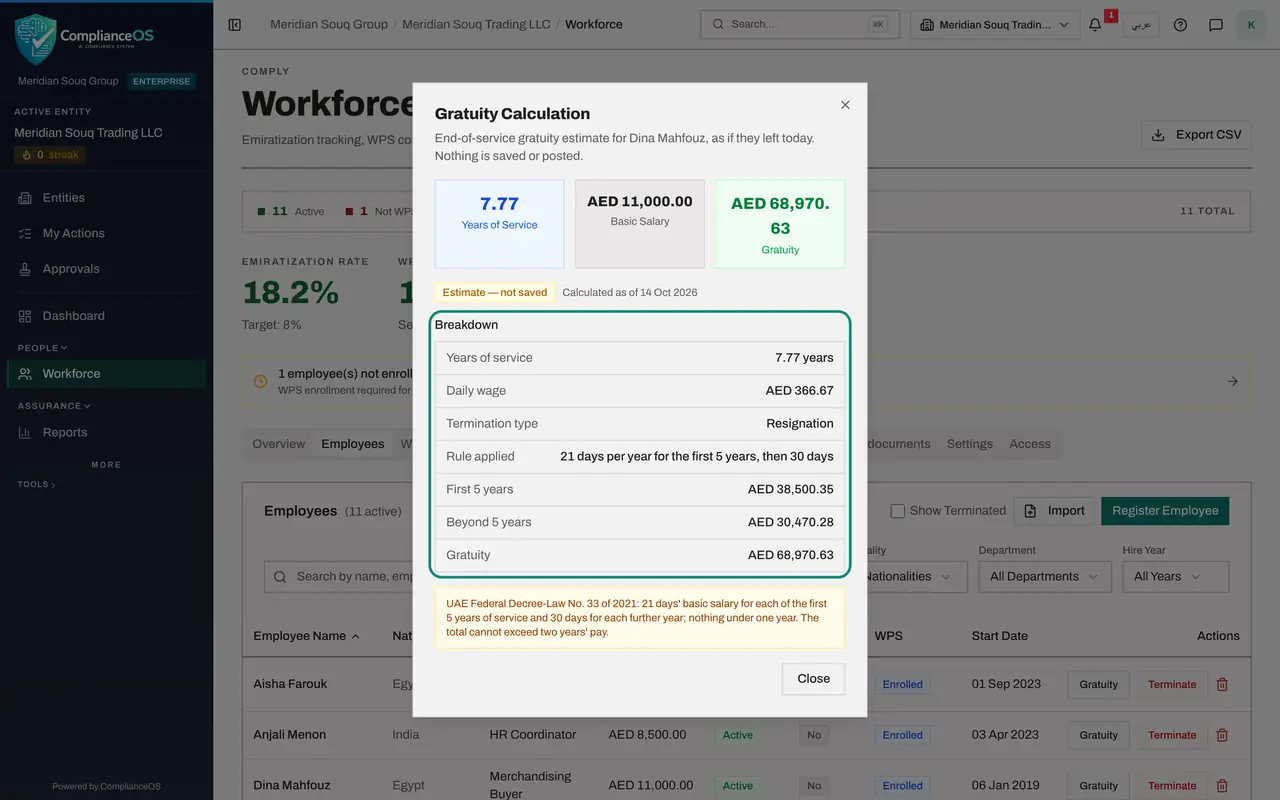
For the detail behind one person's figure, select the Employees tab and then the Gratuity button on that person's row. The window shows an estimate as if they left today: years of service, basic salary and the gratuity. The yellow badge reads Estimate, not saved.
- Select Employees
- Select Gratuity
- 4
Read the breakdown
Breakdown shows how the figure was reached: the rule applied, the daily wage, which is basic salary divided by thirty, and the amounts for the first five years and for the years beyond. The amber note at the bottom states the law: 21 days of basic salary for each of the first five years, 30 days for each further year, nothing under one year, and never more than two years' pay.
- 5
Close and estimate for a recent joiner
Select Close. Now select Gratuity on the row of the store associate who joined a few months ago. The rule applied is less than one year of service, so the gratuity is zero.
- Select Close
- Select Gratuity
- 6
Open an employee's record and select Gratuity
The same estimate is on each employee's record. Select Close, open the store supervisor's record by selecting her name, and select the Gratuity tab. The text under the title repeats that an estimate is not saved and nothing is posted.
- Select Close
- Select Hessa Al Marri
- Select Gratuity
- 7
Select Calculate Gratuity
Select Calculate Gratuity. The figures and the breakdown appear on the page. She has under five years of service, so the rule is 21 days of basic salary for each year. The final gratuity is calculated only when a termination is recorded, which is the subject of the next lesson.
- Select Calculate Gratuity
How to check it worked
You can open an estimate for any active employee, it carries the badge Estimate, not saved, and its breakdown names the rule that was applied.
Common mistakes
- Quoting an estimate to an employee as the amount they will be paid. It assumes they leave today; the final figure is calculated on the real leaving date when the termination is recorded.
- Looking for a saved history of estimates. Estimates are never stored: run one again whenever you need it.
- Expecting allowances to be included. Gratuity is based on basic salary only.
Check your understanding
1. An employee has worked for seven years. Which rule does the estimate apply?
- A.21 days of basic salary for every year
- B.21 days a year for the first five years, then 30 days a year
- C.30 days for every year
- D.One month's total pay
Show answer
Answer: B. 21 days a year for the first five years, then 30 days a year
The first five years earn 21 days of basic salary each, and each further year earns 30 days. The total cannot exceed two years' pay.
2. What does an estimate change in the accounts?
- A.It posts a journal entry
- B.Nothing: it is not saved and nothing is posted
- C.It reduces the provision
- D.It marks the employee as leaving
Show answer
Answer: B. Nothing: it is not saved and nothing is posted
The estimate window says so itself. Only a recorded termination calculates a final gratuity and posts to the ledger.