Lesson 24 of 26
Reem turns activity data into emissions
What you will be able to do
This lesson is for the person who leads sustainability reporting. Reem, the AI agent for ESG, turns a plant's activity data, such as electricity, diesel and fuel used, into emissions and drafts the sustainability report. You will paste the plant's 2025 activity data into the chat, approve her go-ahead and find the report waiting for your review.
Before you start
- You are signed in as the compliance officer, the ESG lead, with access to Meridian Souq Manufacturing FZE.
- You have the plant's 2025 activity data in a spreadsheet: electricity, diesel, LPG and fleet fuel by quarter.
Steps
- 1
Write to Reem
On Meridian Souq Manufacturing FZE, open the AI team's Chat, type @ and pick Reem, the ESG agent, and type: here is our 2025 activity data for the JAFZA plant, copied from our spreadsheet. Please turn it into the 2025 emissions and prepare the 2025 sustainability report for my review. Then paste the table under it: one line per category and quarter, with the period, quantity and unit.
- Type Message to the AI team:
@Ree - Choose RReemAIESG analyst
- Type Message to the AI team:
@Reem here is our 2025 activity data for the JAFZA plant, copied from…
- Type Message to the AI team:
- 2
Select Send
Select Send. Your message appears with the table, and Reem's card under it is marked Working.
- Select Send
- 3
Follow Reem's to-do list
Reem writes her to-do list: check what 2025 data already exists, import your lines as emission records, make sure every record has an emission factor, generate the 2025 report, and send it to you for review.
- 4
Approve Reem's go-ahead
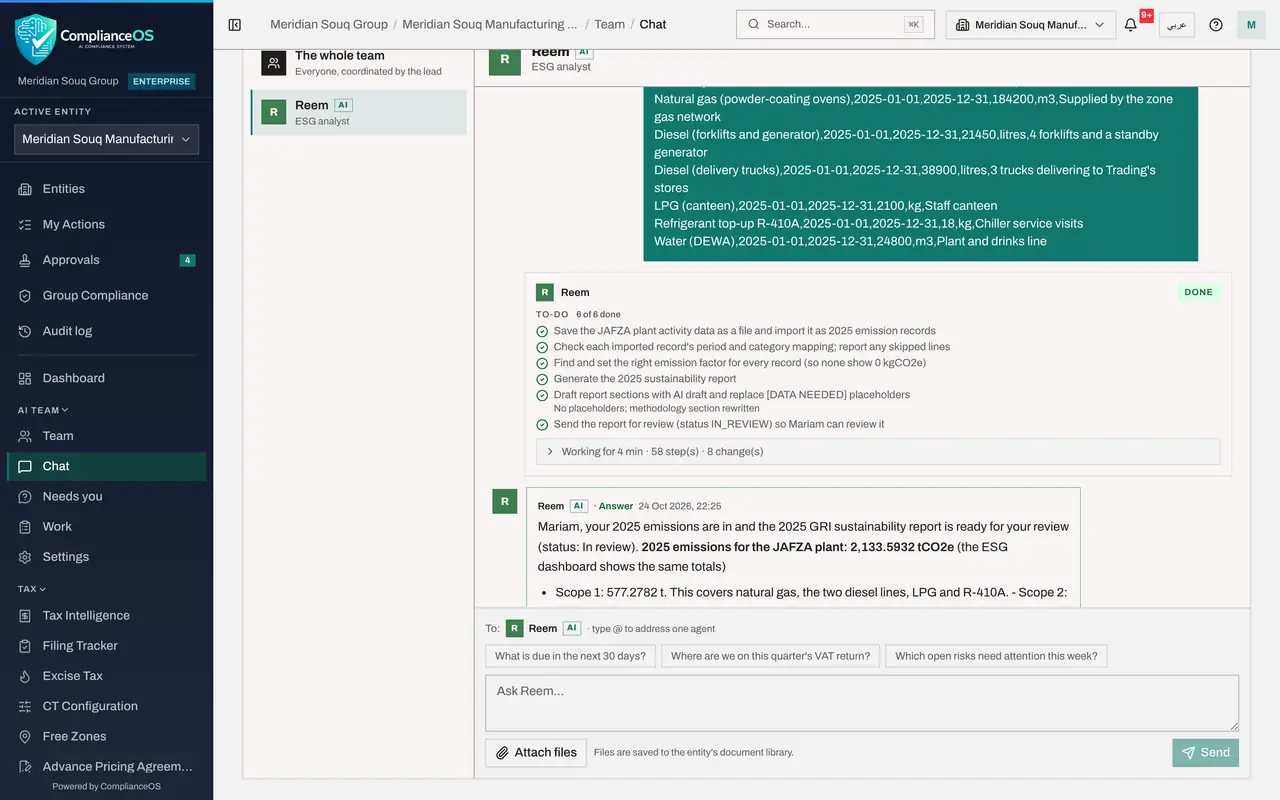
Reem saves your table as a file and imports it, checking for duplicates, then fixes the records that need it. When the report is drafted she asks before sending it for review: the go-ahead sets the report to In review, with a comment on what it was built from. Select Approve.
- Select Approve
- 5
Read Reem's answer
Reem's green Answer gives the 2025 total, about 2,134 tonnes of CO2 equivalent, by scope, and says what she corrected: water the import had filed as electricity, a refrigerant with no factor, and the canteen LPG, bought by weight, which she converted to litres using a density she assumed and says so. Your steps: verify the ten records, confirm the LPG density, confirm whether the delivery trucks are the plant's own, and review the report. She also lists the gaps in the report, such as no social data and no targets.
- 6
See what Reem recorded
On Reem's card, select the line that says how long she worked. The steps show the file she made from your table, the import, each record she corrected and the report she generated.
- Select Worked for 4 min · 59 step(s) · 8 change(s)
- 7
Open ESG and Carbon
In the left menu, open ESG and Carbon. The page opens on the current year, 2026, so its totals are still zero; choose 2025 in the year box at the top right to see the emissions Reem recorded. Under Reports, the 2025 report waits in review for you.
How to check it worked
ESG shows the 2025 emissions recorded from the data and a 2025 report in review. Reem's answer gives the totals by scope and what she needs from you.
Common mistakes
- Pasting only some of the rows. Copy the whole table, with its header row, so Reem can read every line and its unit.
- Leaving an assumption unchecked. Reem says when she assumed a figure, such as the LPG density; confirm it or give the supplier's figure.
- Publishing the report as Reem left it. It is in review for you.
Check your understanding
1. What does Reem need from the activity data?
- A.Only the totals
- B.Each line with its category, period, quantity and unit
- C.The supplier invoices
- D.Nothing
Show answer
Answer: B. Each line with its category, period, quantity and unit
Emissions are worked out line by line from the quantity and its unit, with the right emission factor.
2. Reem asks you to confirm whether the delivery trucks are the plant's own. Why does it matter?
- A.It doesn't
- B.Owned vehicles are the plant's own emissions (scope 1), others are not
- C.For the VAT return
- D.For payroll
Show answer
Answer: B. Owned vehicles are the plant's own emissions (scope 1), others are not
Facts like ownership decide where emissions belong, so the agent asks rather than guessing.